Services

Resources

Company

Our blogs,

AWS

Best Practices

CI/CD

Data Engineering

Go

How To

MLOps

Observability

Performance Optimization

Resiliency

Security

SRE

Load More

AWS

Best Practices

CI/CD

Data Engineering

Go

How To

MLOps

Observability

Performance Optimization

Resiliency

Security

SRE

Load More

Recent talks

Watch Talk

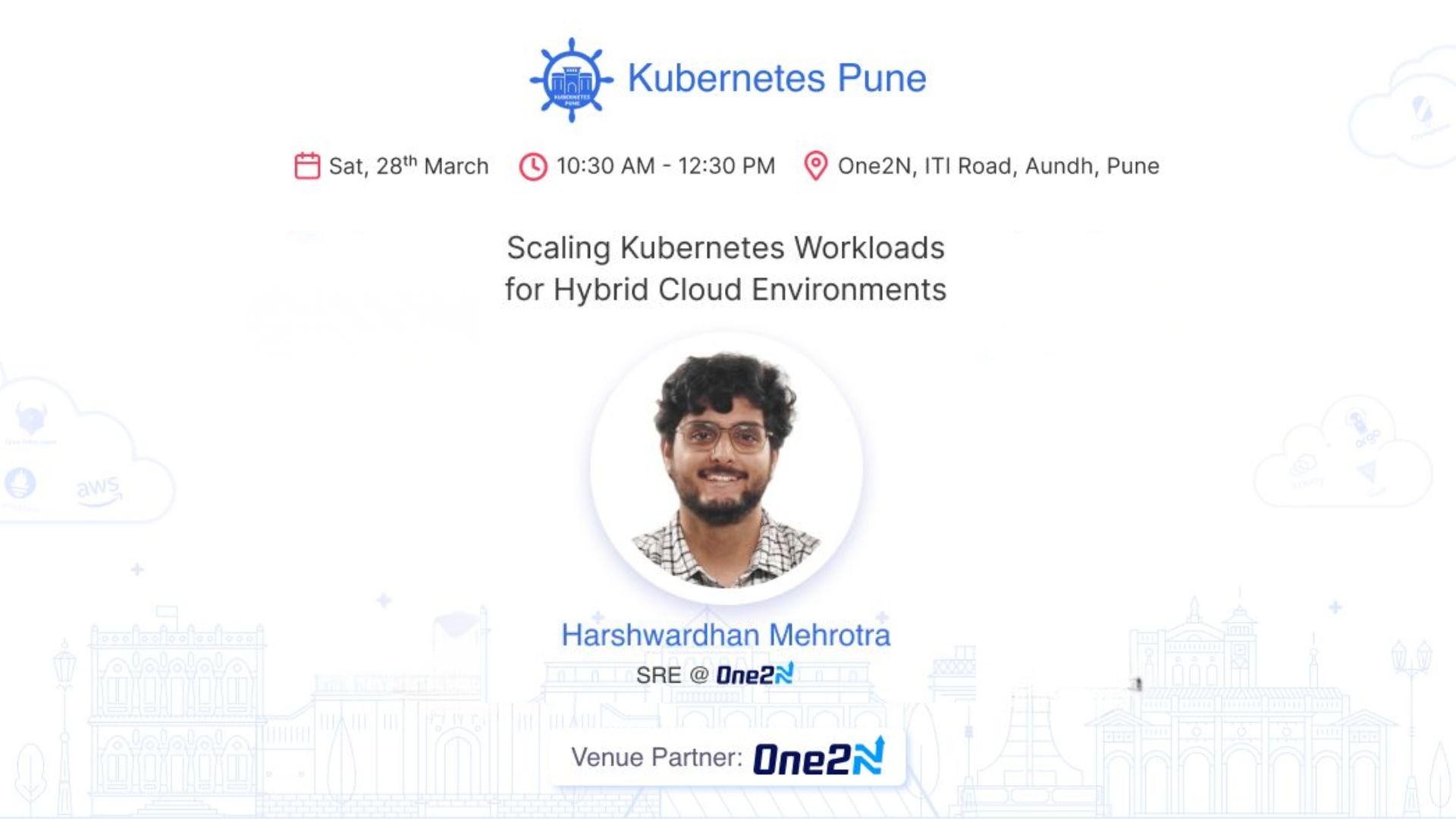
Kubernetes for Hybrid Cloud Environments - Harshwardhan Mehrotra - #60 Kubernetes Pune Meetup

Harshwardhan Mehrotra

SRE @One2N

Scaling Kubernetes workloads across 40+ data centers is hard – especially when you must meet strict data residency and latency requirements while still leveraging the public cloud. In this talk from the Kubernetes Pune Meetup, Harshwardhan Mehrotra (Site Reliability Engineer at One2N) walks through how his team designed and operated an EKS hybrid setup for a large betting platform with data centers across the US, UK, and Europe. You’ll see how they connected on‑prem worker nodes to an AWS EKS control plane, handled networking at scale, and kept the developer experience close to a “normal” EKS cluster. What you’ll learn: - Why EKS hybrid was chosen over fully on‑prem or fully cloud, and how regulatory and latency constraints shaped the architecture. - How to design pod vs node networking, routable vs non‑routable pod networks, and when to bring in BGP. - How to connect 40+ data centers to AWS using Direct Connect / site‑to‑site VPN and Cilium/Calico CNIs. - How to expose apps using F5 and Istio/NGINX ingress when ALB is not an option. - Real‑world issues with DNS (CoreDNS, Route 53 limits, node‑local DNS) and traffic distribution, plus how they fixed them. - Lessons on egress control, firewall bottlenecks, add‑on placement (Argo CD, KEDA, Prometheus, etc.), and building repeatable playbooks for on‑prem nodes. - This talk is ideal for platform engineers, SREs, and architects running Kubernetes across data centers and cloud, or evaluating EKS hybrid for regulated workloads.

Watch Talk

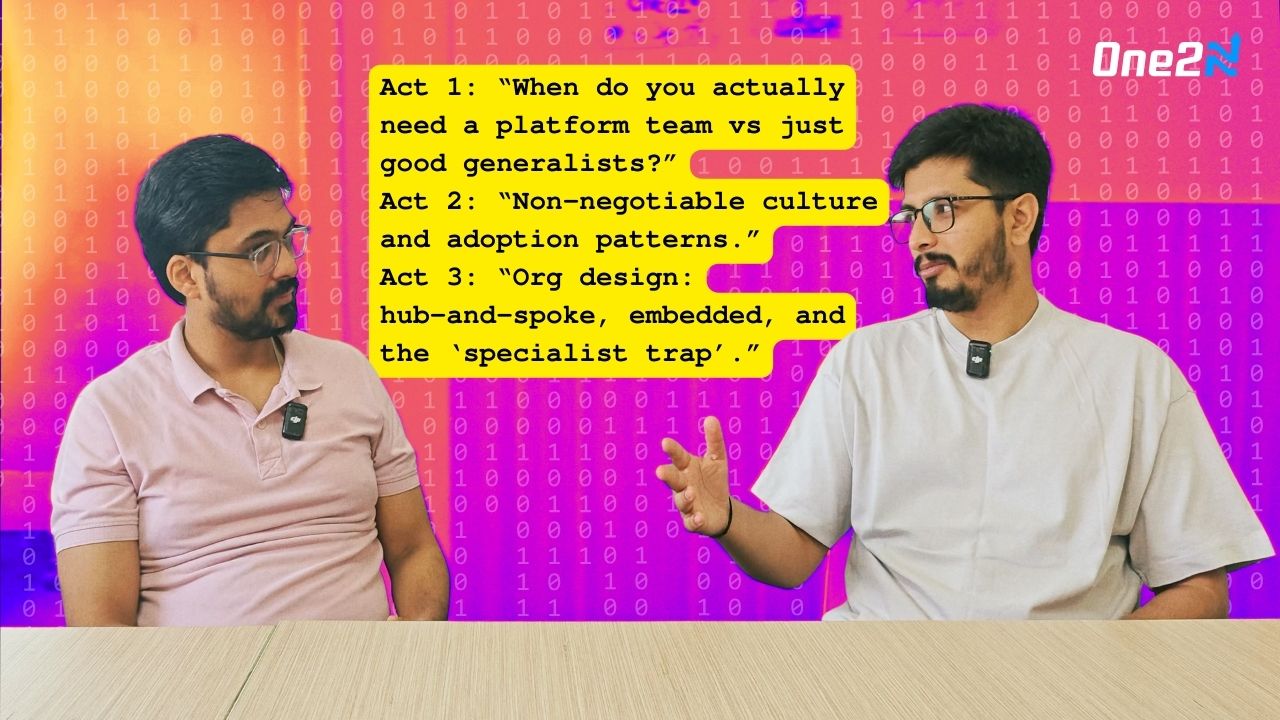
Platform Engineering Strategy: Scaling from 5 to 500 Engineers | One2N Bits Ep. 6

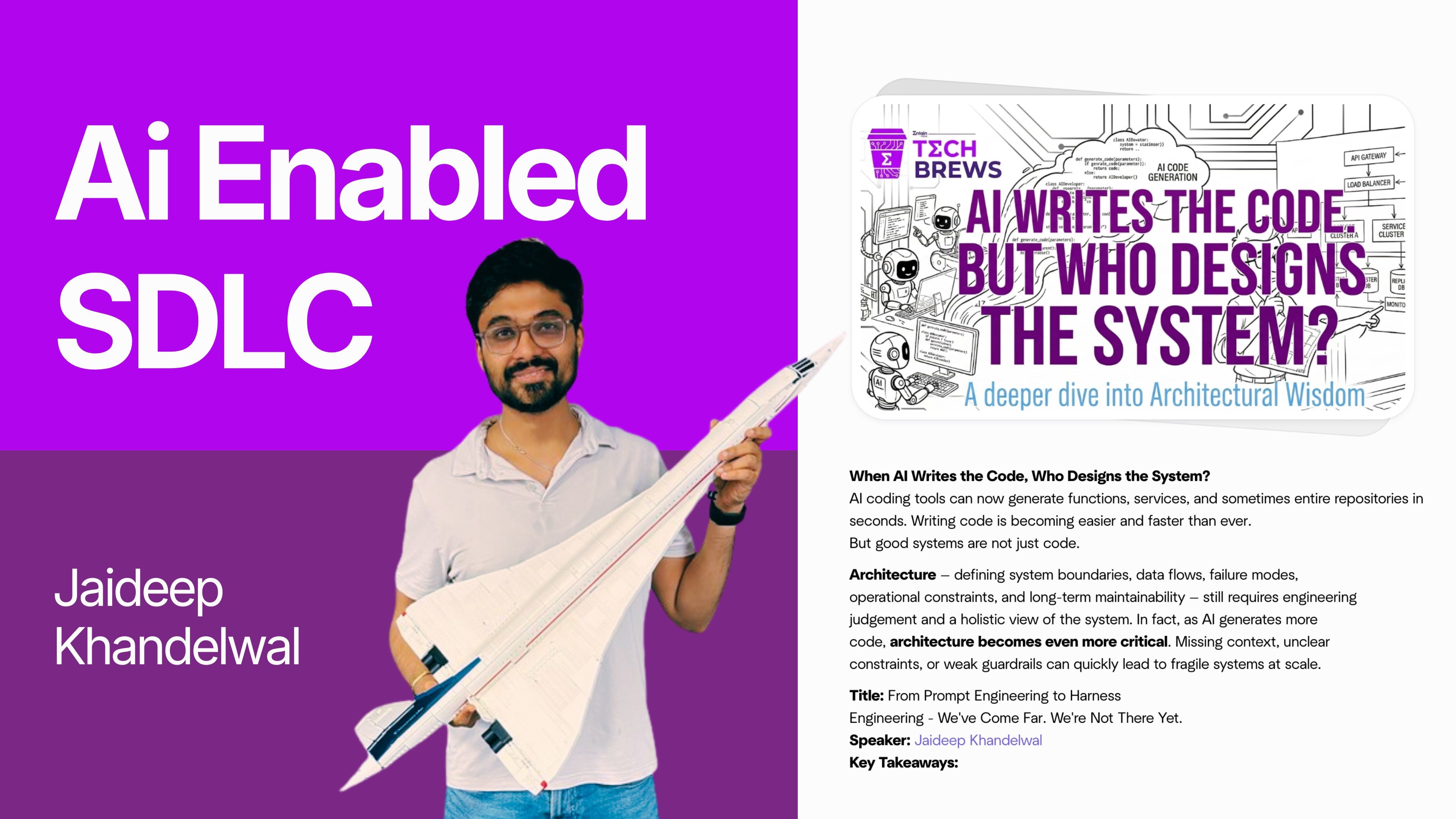
Jaideep Khandelwal

CTO @One2N

Srivatsa RV

SRE @One2N

Platform engineering means very different things depending on where your org is, and most teams don't realize they've been doing it all along. In this One2N Bits episode, Srivatsa (SRE, One2N) and Jaideep (CTO, One2N) put on a strategy hat to break down platform engineering from first principles, not tooling. They cover when you actually need a platform team, what non-negotiables hold at every org size, how to drive adoption without disrupting developers, and the classic specialist trap that growing teams fall into. What you'll learn - Why the line between DevOps, SRE, and platform engineering is intentionally blurry, and when it needs to get sharper - Non-negotiable cultural practices for platform teams, regardless of whether you're 5 or 500 engineers - Hub-and-spoke vs embedded platform engineers: which model works and when - The specialist trap: when generalists are enough, and when you need execution with authority - How shift-left thinking is quietly increasing developer cognitive load Who this is for: Founders and engineering leaders deciding when to spin up a dedicated platform team. Platform engineers and SREs looking to frame their work as a product, not just plumbing. Teams at the 50–200 engineer stage where platform culture either solidifies or fractures. 🔔 Part 2 coming soon: team topologies, org structures, and measuring platform success beyond vanity metrics.

Watch Talk

Kubernetes for Hybrid Cloud Environments - Harshwardhan Mehrotra - #60 Kubernetes Pune Meetup

Harshwardhan Mehrotra

SRE @One2N

Scaling Kubernetes workloads across 40+ data centers is hard – especially when you must meet strict data residency and latency requirements while still leveraging the public cloud. In this talk from the Kubernetes Pune Meetup, Harshwardhan Mehrotra (Site Reliability Engineer at One2N) walks through how his team designed and operated an EKS hybrid setup for a large betting platform with data centers across the US, UK, and Europe. You’ll see how they connected on‑prem worker nodes to an AWS EKS control plane, handled networking at scale, and kept the developer experience close to a “normal” EKS cluster. What you’ll learn: - Why EKS hybrid was chosen over fully on‑prem or fully cloud, and how regulatory and latency constraints shaped the architecture. - How to design pod vs node networking, routable vs non‑routable pod networks, and when to bring in BGP. - How to connect 40+ data centers to AWS using Direct Connect / site‑to‑site VPN and Cilium/Calico CNIs. - How to expose apps using F5 and Istio/NGINX ingress when ALB is not an option. - Real‑world issues with DNS (CoreDNS, Route 53 limits, node‑local DNS) and traffic distribution, plus how they fixed them. - Lessons on egress control, firewall bottlenecks, add‑on placement (Argo CD, KEDA, Prometheus, etc.), and building repeatable playbooks for on‑prem nodes. - This talk is ideal for platform engineers, SREs, and architects running Kubernetes across data centers and cloud, or evaluating EKS hybrid for regulated workloads.

Watch Talk

Platform Engineering Strategy: Scaling from 5 to 500 Engineers | One2N Bits Ep. 6

Jaideep Khandelwal

CTO @One2N

Srivatsa RV

SRE @One2N

Platform engineering means very different things depending on where your org is, and most teams don't realize they've been doing it all along. In this One2N Bits episode, Srivatsa (SRE, One2N) and Jaideep (CTO, One2N) put on a strategy hat to break down platform engineering from first principles, not tooling. They cover when you actually need a platform team, what non-negotiables hold at every org size, how to drive adoption without disrupting developers, and the classic specialist trap that growing teams fall into. What you'll learn - Why the line between DevOps, SRE, and platform engineering is intentionally blurry, and when it needs to get sharper - Non-negotiable cultural practices for platform teams, regardless of whether you're 5 or 500 engineers - Hub-and-spoke vs embedded platform engineers: which model works and when - The specialist trap: when generalists are enough, and when you need execution with authority - How shift-left thinking is quietly increasing developer cognitive load Who this is for: Founders and engineering leaders deciding when to spin up a dedicated platform team. Platform engineers and SREs looking to frame their work as a product, not just plumbing. Teams at the 50–200 engineer stage where platform culture either solidifies or fractures. 🔔 Part 2 coming soon: team topologies, org structures, and measuring platform success beyond vanity metrics.

Watch Talk

Kubernetes for Hybrid Cloud Environments - Harshwardhan Mehrotra - #60 Kubernetes Pune Meetup

Harshwardhan Mehrotra

SRE @One2N

Scaling Kubernetes workloads across 40+ data centers is hard – especially when you must meet strict data residency and latency requirements while still leveraging the public cloud. In this talk from the Kubernetes Pune Meetup, Harshwardhan Mehrotra (Site Reliability Engineer at One2N) walks through how his team designed and operated an EKS hybrid setup for a large betting platform with data centers across the US, UK, and Europe. You’ll see how they connected on‑prem worker nodes to an AWS EKS control plane, handled networking at scale, and kept the developer experience close to a “normal” EKS cluster. What you’ll learn: - Why EKS hybrid was chosen over fully on‑prem or fully cloud, and how regulatory and latency constraints shaped the architecture. - How to design pod vs node networking, routable vs non‑routable pod networks, and when to bring in BGP. - How to connect 40+ data centers to AWS using Direct Connect / site‑to‑site VPN and Cilium/Calico CNIs. - How to expose apps using F5 and Istio/NGINX ingress when ALB is not an option. - Real‑world issues with DNS (CoreDNS, Route 53 limits, node‑local DNS) and traffic distribution, plus how they fixed them. - Lessons on egress control, firewall bottlenecks, add‑on placement (Argo CD, KEDA, Prometheus, etc.), and building repeatable playbooks for on‑prem nodes. - This talk is ideal for platform engineers, SREs, and architects running Kubernetes across data centers and cloud, or evaluating EKS hybrid for regulated workloads.

Watch Talk

Platform Engineering Strategy: Scaling from 5 to 500 Engineers | One2N Bits Ep. 6

Jaideep Khandelwal

CTO @One2N

Srivatsa RV

SRE @One2N

Platform engineering means very different things depending on where your org is, and most teams don't realize they've been doing it all along. In this One2N Bits episode, Srivatsa (SRE, One2N) and Jaideep (CTO, One2N) put on a strategy hat to break down platform engineering from first principles, not tooling. They cover when you actually need a platform team, what non-negotiables hold at every org size, how to drive adoption without disrupting developers, and the classic specialist trap that growing teams fall into. What you'll learn - Why the line between DevOps, SRE, and platform engineering is intentionally blurry, and when it needs to get sharper - Non-negotiable cultural practices for platform teams, regardless of whether you're 5 or 500 engineers - Hub-and-spoke vs embedded platform engineers: which model works and when - The specialist trap: when generalists are enough, and when you need execution with authority - How shift-left thinking is quietly increasing developer cognitive load Who this is for: Founders and engineering leaders deciding when to spin up a dedicated platform team. Platform engineers and SREs looking to frame their work as a product, not just plumbing. Teams at the 50–200 engineer stage where platform culture either solidifies or fractures. 🔔 Part 2 coming soon: team topologies, org structures, and measuring platform success beyond vanity metrics.

Subscribe for more such content

Get the latest in software engineering best practices straight to your inbox. Subscribe now!

Hold for 2 seconds to verify

Security powered by One2N

Subscribe for more such content

Get the latest in software engineering best practices straight to your inbox. Subscribe now!

Hold for 2 seconds to verify

Security powered by One2N

Subscribe for more such content

Get the latest in software engineering best practices straight to your inbox. Subscribe now!

Hold for 2 seconds to verify

Security powered by One2N